ATOM ECONOMY
ABSTRACT:
Chemistry never had a grandma to say "make sure you finish all your greens."

In a lot of reactions your desired product isn't the only product that's made!
That means you rarely yield 100% of your desired product and instead there are waste products.
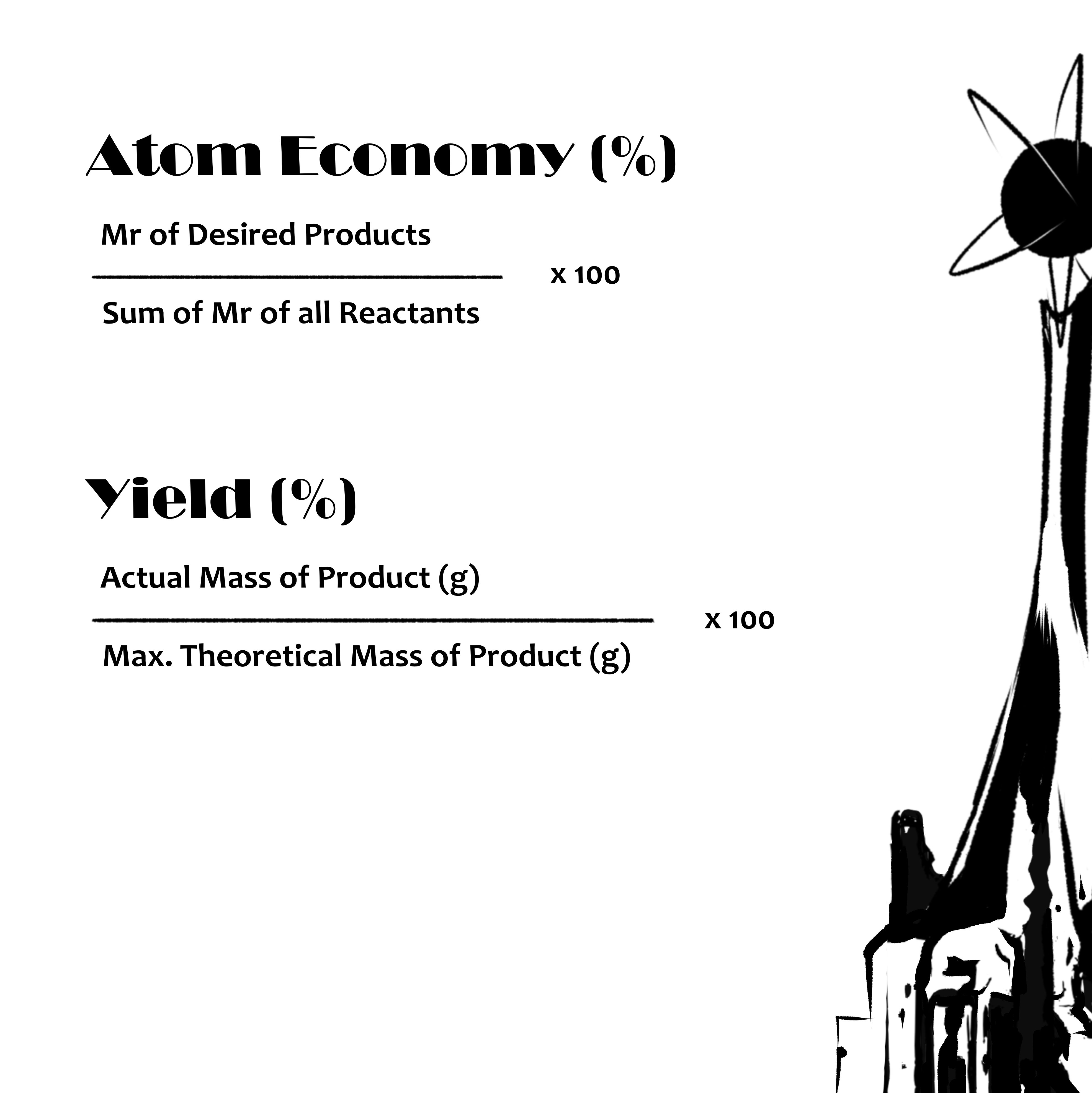
Atom economy is an equation to help work out how efficient your reaction will be, which is critical in reducing waste and making the most out of what you have.
METHODOLOGY:
- Watched 2 Youtube videos that covered atom economy.
- Read BBC Bitesize AQA information on atom economy and % yield.
- Completed associated quiz and questions.
- Asked ChatGPT to generate questions to complete, comparing answers after.
DISCUSSION AND RESULTS:
Atom economy is about efficiency. Cost and resources.
The formula compares the mass of the product you want to the total mass of all products in the reaction.
A higher atom economy means there is more mass of the product you wanted versus less by-product mass.
This can help build a picture if whether or not a reaction is cost and resource effective.

It's got me thinking about how much this impacts the designs of future medicines.
Medicines have to be cost-effective to make it through marketing - there's a balance between the positive impact it will have on patients and the cost and resources it takes to produce, which will affect whether or not it makes it to production.

So have there been groundbreaking medicines in the past that were scrapped because the atom economy was too low?

Are there medicines now, which are even more efficient and popular than when they were first discovered because using atom economy has helped refine how they are synthesized?
LOGICAL CONCLUSIONS:
I now understand that atom economy is a tool for evaluating and improving the chemical process.
In the pharmaceutical industry, where drug production must be high-yielding and environmentally conscious, atom economy is a valuable concept.
It helps design cleaner reactions with less waste and more accessible medicines.


 PharmArtist